
Redmond Directory Collections by Year
Redmond city directory research spans several source types. Polk and Company published regional volumes grouping Bellevue, Kirkland, and Redmond. Older telephone books give a different snapshot, while the Historical Society and King County Library System hold sources that explain a name or address. No complete Redmond-only printed run was confirmed. Several year references come from genealogy catalogs or Washington Ecology reports, so ask a librarian to confirm the shelf copy and call number before visiting.
| Redmond collection | Dated coverage | Custodian | Access route |
|---|---|---|---|
| Bellevue, Kirkland, Redmond City Directory | 1976, 1980, 1982, 1985 | Established genealogy catalog; Polk and Company | Confirm with Washington State Library or KCLS |
| Polk regional directory references | 1978, 1979, 1992-2017 | Washington Ecology reports | Use as year leads, then locate the volume |
| Kirkland-Redmond telephone books | April 1944 and June 1949 | Kirkland Heritage digital PDFs | Free digital volumes |
| Sammamish Valley News | Founded 1946; through 1997 | Redmond Historical Society | Online search and office appointment |
| Seattle Times microfilm | 1983-2009 published run | KCLS Redmond | In-library; confirm access first |
A cited year is not the same as a verified volume on a shelf. Ecology reports establish that editions were consulted, but not where a copy now sits. Phone books also differ from Polk city directories. They list subscribers, businesses, a locality, and a dial number, not a full household. Record the source type as carefully as the year.
Redmond Library Genealogy Routes
The KCLS History and Genealogy collection connects Redmond researchers with Ancestry Library Edition, FamilySearch, census sources, Sanborn maps, National Archives links, and newspaper tools. Ancestry Library Edition is used in the library and requires a library card. FamilySearch is free. The Bellevue Genealogy collection is the stronger regional specialist shelf for indexes, regional histories, cemetery and marriage records, passenger lists, and periodicals.
The KCLS genealogy gateway shows the range of library sources available to Redmond researchers.
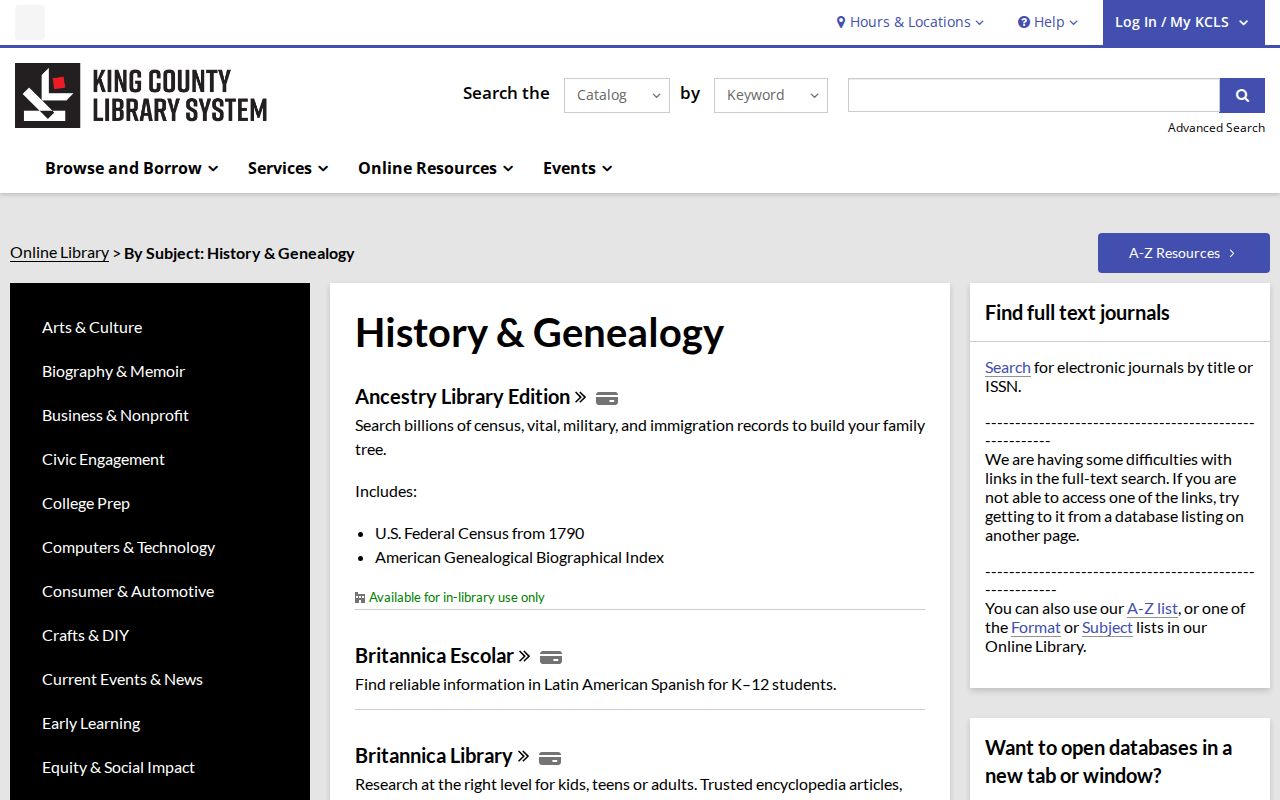
The image is a useful starting screen for moving from a directory name to census, map, and family-history evidence.
The Redmond branch remains a practical first stop. Its current building opened in 1999, while the town's library story reaches back to a 1927 Nokomis collection. Staff can help identify a database, check microfilm equipment, or route a question to a specialist. The branch's published list includes Seattle Times microfilm from 1983 through 2009. Call ahead because a catalog entry does not ensure that a reader, reel, or specialist is available that day.
Check the KCLS newspaper microfilm list before planning a Redmond city directory visit.
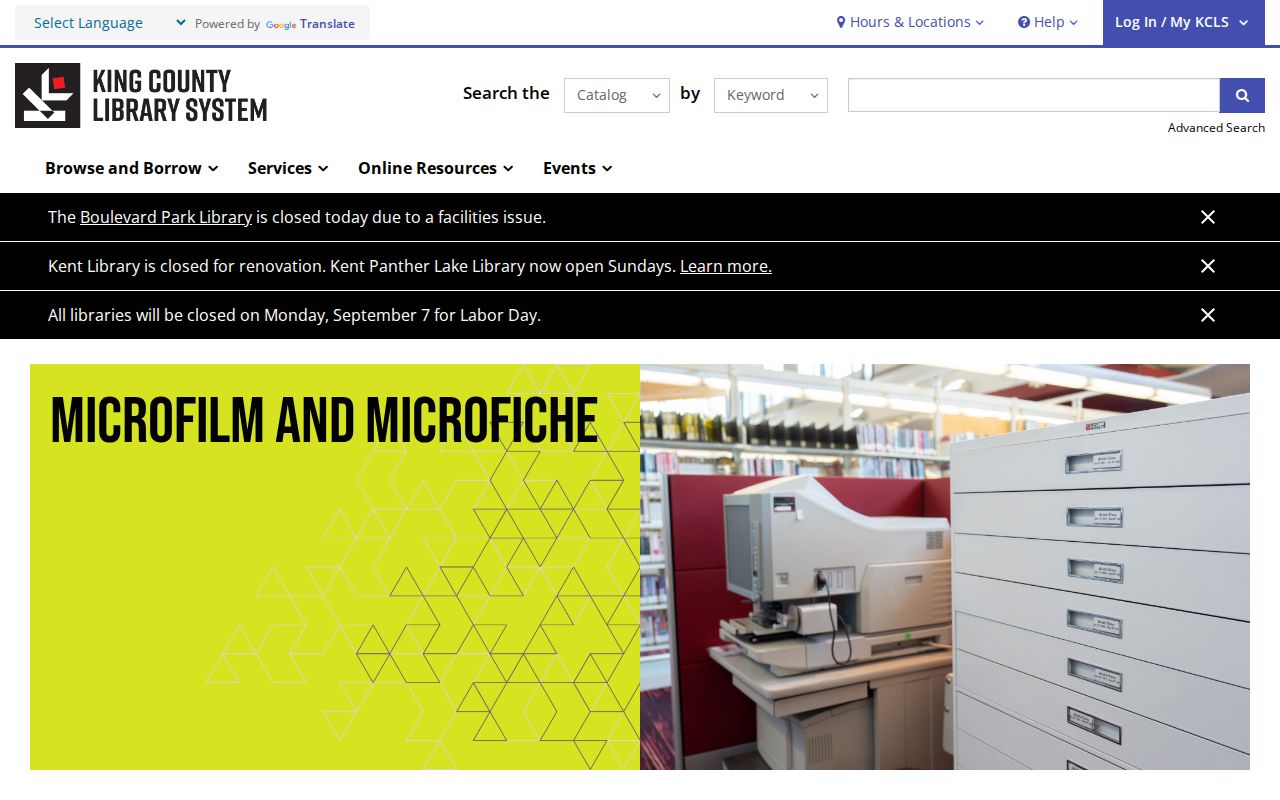
The captured KCLS screen points to newspaper runs that can fill gaps between directory years.
Redmond Historical Directory Archive
The Redmond Historical Society Online Archives adds detail that a city directory line cannot carry. Its Past Perfect catalog contains thousands of photographs and documents, including obituaries, oral histories, yearbooks, and newspapers. The Sammamish Valley News archive can be searched by date, person, business, or phrase. Quotation marks help with an exact phrase.
Research appointments are advised. The society lists 425-885-2919 and info@redmondhistoricalsociety.org, with its research location at 7802 168th Ave NE. A request should name the person or business, likely year, address or locality, and source already checked. Staff may connect a sparse entry to a photo, school item, advertisement, or oral history without suggesting that a historic address is current.
Collections on Chinese American legacies, the wartime incarceration of three Redmond families, local businesses, the King County Stockade, and the old fire house supply context for family research. They show why a resident trail needs community history, not just names.
Decode a Redmond Directory Entry
The 1944 and 1949 telephone books establish which fields can safely be read from Redmond listings. A line may show a surname, given name or initial, locality or street note, historic phone number, and a business or institution. An advertisement may add a service category. These books do not supply a birth date, legal ownership, citizenship, complete household, or present residence.
| Name | Surname, given name, middle initial, and a title when printed |
|---|---|
| Place | Street, locality, residence note, or rural route as printed |
| Telephone | Historic exchange or dial number, kept with its date |
| Business detail | Business name, service category, or advertisement text |
| Citation | Volume date and page for a sound comparison |
- Criss-cross directory
- A later directory section arranged by street or phone number instead of surname.
- Householder index
- A list centered on the main listed resident, not proof of every household member.
- Abbreviation key
- The publisher's legend for short forms and symbols in that exact volume.
- Locality
- The community label printed with an entry, which may not match modern city limits.
A later Polk volume may contain more fields. Read its own key before interpreting a mark, since conventions can change by publisher and year.
Redmond Telephone Books Before ZIPs
The April 1944 Kirkland-Redmond book and June 1949 volume preserve listings that cannot be searched with today's full street-and-ZIP format. The older book includes personal and business entries, including a local care institution with a Redmond number. The later volume includes Redmond surnames and a Redmond Oil Co. entry with a rural route and box. Such forms are dated evidence, not mistakes to correct.
Copy a rural route exactly. Then compare it with a historic map, newspaper advertisement, deed, Sanborn map, or later city directory. The method can connect an old locality to a modern parcel without claiming a perfect match. The 1949 volume is useful as a continuity test against 1944, but five years is enough time for a family, business, number, or route to change.
Redmond Directory Time Markers
Local boundaries changed around the directory dates. Redmond incorporated in 1912. Education Hill was annexed in 1951, Overlake in 1962, Viewpoint in 1964, and Bear Creek in 1966. East Redmond existed as a separate incorporated place from 1956 until 1964. Search a historic entry under the place name and jurisdiction used at that date.
| Date | Redmond research marker |
|---|---|
| 1888 | The railway helped turn the settlement into a commercial center. |
| 1912 | Redmond incorporated, creating a municipal record trail. |
| 1944 and 1949 | Digitized telephone books provide dated local listings. |
| 1976-1985 | Confirmed Polk catalog years provide regional directory anchors. |
| 1983-2009 | Published Seattle Times microfilm run at KCLS Redmond. |
No verified first or last printed Redmond city directory year was found. Use confirmed books, catalog references, and dated local events.
Trace Redmond Families Across Directories
A family-history search works best as a dated sequence. Start with the exact text in the oldest known Redmond city directory. Test initials and spelling variants before deciding a person is absent. Record the locality, street or route, phone, business role, volume, and page. Compare the next available year rather than treating a long run as complete.
- Search the surname, then initials and alternate spellings in the telephone books and available Polk years.
- Copy each address, locality, number, and publication date exactly. Do not modernize a rural route.
- Pair the listing with a released federal census schedule, subject to the 72-year release rule.
- Search the Historical Society catalog and newspaper archive for the same name, school, business, or phrase.
- Use an obituary, cemetery index, deed, yearbook, or vital record to test identity and explain a change.
A disappearance has many causes. A subscriber may have moved, died, changed a surname, stopped paying for a listing, or appeared under another household or business. KCLS obituary research accepts one noncommercial request at a time and asks for a full name, death place and date, and publication details when known. Most requests take up to 14 working days, but the service does not search every newspaper.
Map Redmond Directory Localities
Redmond's named planning areas and old road labels help place vague entries. The city uses ten planning neighborhoods, including Downtown, Overlake, Bear Creek, Sammamish Valley, Education Hill, Grass Lawn, Idylwood, North Redmond, Southeast Redmond, and Willows/Rose Hill. These are planning boundaries, not postal zones or proof of residence.
Historic maps label roads such as York Road, Conrad Olson Road, Perrigo Road, Railroad Avenue, Homestead Drive, Grass Lawn Road, Tosh Road, and Campton Road. Pair a place term with the person, business, directory year, or newspaper phrase. For modern address-keyed work, move to the Redmond street directory once the historic locality is mapped.
Maps add geographic context. They do not turn a city directory entry into proof of a current address.
Annexation is especially important when a listing falls between the 1940s and the 1970s. City materials report that about 65 percent of Redmond's annexed acreage entered the city from 1950 through 1970. A person could keep a familiar Redmond locality while the office responsible for a permit, tax record, or civic file changed. East Redmond's brief period as a separate city adds another name worth testing. Write down both the printed locality and the date before opening a modern map.
A map-and-directory match should be checked against one more dated source. Newspapers can show a business advertisement or social item. A deed can tie a named party to a legal description. A released census can show a household at a past census date. Yearbooks and oral histories may explain school or community ties. Each source answers a narrower question, and agreement among them is more useful than a modern guess based on a familiar surname.
When online search stalls, use the full access chain: KCLS reference help, an in-library database or microfilm reader, a Redmond Historical Society appointment, Washington State Library catalog help, and Washington Digital Archives collection indexes. Phone, email, and mail questions remain useful because older books may not be indexed at page level. Give staff a tight request with the name, spelling variants, year span, locality, and title already searched. That saves time and makes a negative response much more meaningful.